
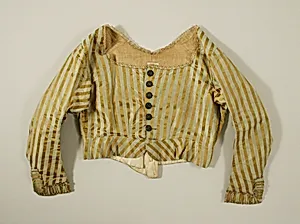
Bodice
Unknown Artist
18th century
Medium
silk, steel
Classification
Bodice
Culture
American or European
Department
Costume Institute
Museum
Metropolitan Museum of Art, New York, NY
Credit
Gift of Mr. Lee Simonson, 1939
Accession Number
C.I.39.13.76
Rights
Public Domain
Art Historical Context
Step into the opulent world of 18th-century fashion with this *Bodice*, a testament to the era's masterful blend of elegance and engineering. Crafted from luxurious silk and reinforced with steel, this garment from the Costume Institute exemplifies the structured silhouettes that defined women's attire during the Enlightenment period. The silk provided a shimmering, tactile surface ideal for lavish social occasions, while the steel boning—likely inserted as stays—created the coveted conical torso shape, offering both support and a dramatic hourglass form. Dating to the 18th century and attributed to either American or European makers, the bodice reflects the transatlantic exchange of style, where European trends influenced colonial wardrobes. Such pieces were essential for formal dress, laced tightly over chemises and paired with wide skirts or panniers, embodying the Rococo emphasis on ornamentation and poise. The unknown artist's skill lies in seamlessly integrating rigid steel with fluid silk, a technique that balanced beauty with practicality amid corsetry's evolution. Generously gifted to the Metropolitan Museum of Art in 1939 by theater designer Mr. Lee Simonson, this bodice preserves a slice of sartorial history. It invites us to ponder the women who wore it—perhaps at balls or assemblies—highlighting how fashion both constrained and empowered in a transformative age. (198 words)