
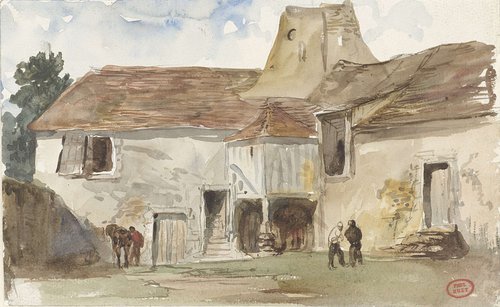
Boerderij te Guibray
1813 - 1869
Medium
brush
Dimensions
239; 147
Rights
Public Domain
About this artwork
penseel in waterverf
Art Historical Context
**Boerderij te Guray** is a delicate watercolor sketch by Paul Huet, a prominent French Romantic landscape painter active from the early 19th century until his death in 186. Created with brush in watercolor—known in Dutch as *penseel in waterverf*—this small work measures just 147 mm high by 239 mm wide, suggesting it was likely a preparatory study or intimate plein-air capture. Huet's title, translating to "Farm at Guibray," evokes rural scene from Normandy or a similar French countryside locale, where he often wandered to document nature's fleeting moods. Huet, influenced by English landscape masters like John Constable, bridged Neoclassicism and the emerging Barbizon school, emphasizing atmospheric effects and natural light over idealized compositions. Watercolor's fluid medium allowed him to layer translucent washes, capturing the soft interplay of sky, foliage, and humble farm structures with remarkable sensitivity. This technique was revolutionary for its time, enabling artists to work swiftly outdoors and convey emotion through subtle color and texture. For visitors, this piece highlights Romanticism's celebration of everyday rural life amid France's post-Revolutionary shifts toward modernity. Though modest in scale, it embodies Huet's lifelong passion for the French landscape, offering a window into 19th-century pastoral tranquility. (198 words)
About the Artist
Paul Huet · 1803–1869
Paul Huet was born in Paris in 1803 and emerged as one of the founding figures of French Romantic landscape painting, a pioneer who helped chart the course from the classical tradition of the previous century toward the freer, more emotionally charged approach to nature that would define the Romantic era. As a young man he studied briefly with Pierre-Henri de Valenciennes and Antoine-Jean Gros, bu...