
Boerenhofstede
1890 - 1900
Medium
oil on canvas
Dimensions
3.1; 72; 52; 14
Rights
Public Domain
About this artwork
oil on canvas
Art Historical Context
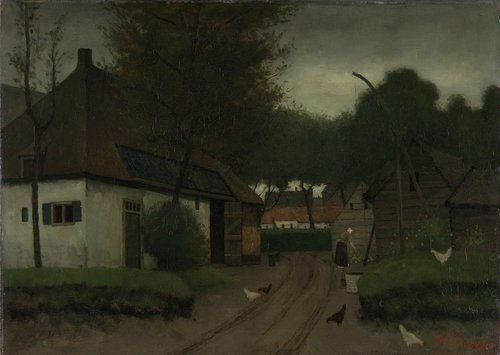
Eduard Karsen's *Boerenhofstede* (Farmstead), painted between 1890 and 1900, captures the quiet essence of rural Dutch life in an oil-on-canvas work measuring 52 cm high by 72 cm wide. As a prominent figure in the later Hague School tradition, Karsen specialized in atmospheric landscapes that evoke the moody skies and earthy tones of the Netherlands' countryside. This piece, now housed in the Rijksmuseum, reflects the movement's emphasis on realism and natural light, portraying a humble farmstead amid expansive fields—a poignant snapshot of agrarian existence at the fin de siècle. Karsen's masterful use of oil on canvas allowed him to layer thick impasto for textured foliage and subtle gradations of gray-blue skies, hallmarks of Hague School techniques influenced by earlier masters like Jacob Maris. The medium's versatility enabled vivid contrasts between the sturdy farmhouse and surrounding landscape, inviting viewers to feel the damp chill of a Dutch autumn. Though modest in scale, its dimensions suit intimate contemplation, much like a window into everyday heritage. Housed in Amsterdam's Rijksmuseum, *Boerenhofstede* underscores the cultural importance of preserving Dutch regional identity during a time of rapid industrialization. It reminds us of the enduring beauty in simplicity, offering modern visitors a serene escape into 19th-century Holland.
About the Artist
Eduard Karsen · 1860–1941
One of the Amsterdam Impressionists, Karsen focused on painting veiws of Amsterdam canals, villages, and farms. His works reflect the stillness of their subjects and the artist's inner state of mind, rather than the commotion of the city.