
Boerenhuizen in vlak land
Medium
brush
Dimensions
177; 304
Rights
Public Domain
About this artwork
penseel in grijsbruin
Art Historical Context
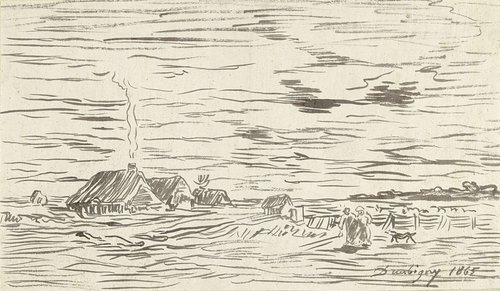
**Boerenhuizen in vlak land (Farmhouses in Flat Land)** Charles-François Daubigny, leading figure of the Barbizon School, created this intimate landscape sketch in 1865. Measuring just 177 × 304 mm, the work captures rural farmhouses nestled in expansive, flat countryside using a simple brush technique in gray-brown tones ("penseel in grijsbruin"). Daubigny's loose, expressive brushwork evokes the serene, everyday beauty of the French countryside, a hallmark of his plein air practice along the Seine and Oise valleys. As a precursor to Impressionism, Daubigny emphasized natural light and atmosphere over precise detail, influencing artists like Monet and Van Gogh. This modest study exemplifies his fascination with humble rural scenes, rendered swiftly to preserve fleeting impressions. The monochromatic palette heightens the mood of quiet vastness, inviting viewers to feel the open horizon's tranquility. Displayed in museums today, it offers a glimpse into 19th-century landscape traditions, bridging Romanticism and modernity through Daubigny's innovative sketching approach. A perfect gem for contemplating nature's subtle poetry.
About the Artist
Charles-François Daubigny · 1817–1878
Charles-François Daubigny was born on February 15, 1817, in Paris into a family of artists, with his father, Edmé-François Daubigny, a classical landscape painter, and his uncle, Pierre Daubigny, a miniaturist, providing his initial artistic training. He further studied under Jean-Victor Bertin, Jacques Raymond Brascassat, and Paul Delaroche at the École des Beaux-Arts, though he quickly moved bey...