
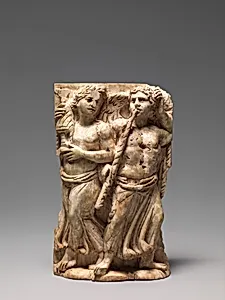
Bone Carving, Possibly of a Dionysiac Revel
Unknown Artist
300–500
Medium
Ivory
Dimensions
Overall: 3 7/8 x 2 3/8 x 13/16 in. (9.8 x 6 x 2 cm)
Classification
Ivories-Elephant
Culture
Byzantine
Department
Medieval Art
Museum
Metropolitan Museum of Art, New York, NY
Credit
Gift of J. Pierpont Morgan, 1917
Accession Number
17.190.74
Rights
Public Domain
Tags
Art Historical Context
This exquisite ivory carving, possibly depicting a Dionysiac revel hails from the Byzantine world between 300 and 500 CE. Measuring just under 4 inches long, it captures a lively scene of men and women in music and merriment, evoking the ecstatic rituals honoring Dionysus, the Greek god of and revelry. Though the artist remains unknown, the work reflects the enduring pagan traditions in early Byzantine culture, a period bridging late Roman antiquity and the rise of Christianity. Carved from elephant ivory—a prized luxury material symbolizing wealth and craftsmanship—the piece showcases the intricate low-relief techniques favored in Byzantine ivories. These small, portable objects were likely used as handles, caskets, or devotional items, blending secular joy with artistic finesse. Its survival into the Medieval era underscores the cultural fusion of classical mythology and emerging Christian iconography. Housed in the Metropolitan Museum of Art's Medieval Art department as a gift from J. Pierpont Morgan in 1917, this relic invites us to ponder the vibrant social life of Byzantium, where music and dance pulsed through both festivals and daily life. A testament to forgotten festivities!