
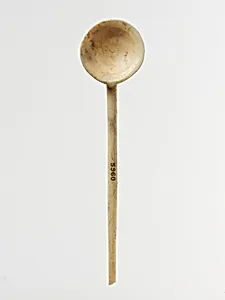
Bone spoon
Unknown Artist
1st century CE
Medium
Bone
Dimensions
H.: 4 1/4 in. (10.8 cm)
Classification
Miscellaneous-Bone, Ivory
Culture
Roman
Department
Greek and Roman Art
Museum
Metropolitan Museum of Art, New York, NY
Credit
The Cesnola Collection, Purchased by subscription, 1874–76
Accession Number
74.51.5198
Rights
Public Domain
Art Historical Context
This delicate bone spoon, crafted in the 1st century CE during the height of the Roman Empire, a glimpse into the everyday of ancient Roman life. Measuring just 4¼ inches (10.8 cm) in height, it exemplifies utilitarian art from a culture renowned for its practical craftsmanship. Made from animal bone—a readily available, lightweight material—this spoon was likely used for eating, mixing, or serving food, highlighting how Romans valued functional beauty in household items. Bone carving was a widespread technique in Roman workshops, where artisans shaped durable, ivory-like surfaces through careful grinding and polishing. Though simple in form, such objects reveal the empire's sophisticated division of labor and access to everyday luxuries, even among common folk. Part of the Cesnola Collection at The Metropolitan Museum of Art—acquired through public subscription in 1874–76—this spoon bridges the gap between elite treasures and ordinary tools, underscoring Rome's blend of utility and subtle elegance. Today, it invites us to ponder the uncelebrated hands that fashioned these tools, preserving a tangible link to the scents of Roman kitchens and the rhythms of imperial daily life.