
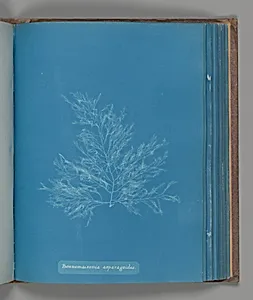
Bonnemaisonia asparagoides
ca. 1853
Medium
Cyanotype
Dimensions
Image: 25.3 x 20 cm (9 15/16 x 7 7/8 in.)
Classification
Photographs
Department
Photographs
Museum
Metropolitan Museum of Art, New York, NY
Credit
Gilman Collection, Purchase, The Horace W. Goldsmith Foundation Gift, through Joyce and Robert Menschel, 2005
Accession Number
2005.100.557 (85)
Rights
Public Domain
Art Historical Context
Anna Atkins's *Bonnemaisoniaagoides*, created around 1853, is a stunning cyanotype photogram capturing the delicate fronds of this red seaweed species. Atkins, a pioneering British photographer botanist, produced these images by placing actual specimens directly on light-sensitive paper coated with ferric ammonium citrate and potassium ferricyanide—a process invented by Sir John Herschel in1842. Exposed to sunlight, the areas shielded by the algae remained white, while the rest turned a vivid Prussian blue, yielding ethereal, camera-less impressions that blend scientific precision with artistic elegance. This work exemplifies Atkins's groundbreaking *Photographs of British Algae: Cyanotype Impressions* (1843–1853), the world's first book illustrated entirely with photographs. As a woman in Victorian science, Atkins self-published this three-volume masterpiece to document Britain's marine flora more accurately than hand-drawn illustrations allowed. Her cyanotypes not only advanced photogram techniques but also democratized scientific visualization, influencing fields from botany to modern abstract photography. Housed in The Metropolitan Museum of Art's Gilman Collection, this 25.3 x 20 cm print invites visitors to marvel at nature's intricate forms frozen in time, a testament to Atkins's visionary fusion of art, science, and innovation.
About the Artist
Anna Atkins · 1799–1871
Anna Atkins (née Children), born on March 16, 1799, in Tonbridge, Kent, England, grew up immersed in the world of science thanks to her father, John George Children, a prominent chemist, zoologist, and curator at the British Museum. After her mother Hester's death shortly after childbirth in 1800, Anna formed a close bond with her father, receiving an exceptional scientific education rare for wome...