
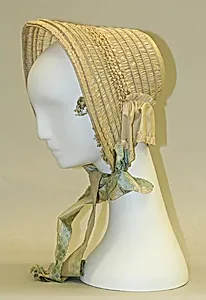
Bonnet
Unknown Artist
1849–51
Medium
silk
Classification
Bonnet
Culture
American
Department
Costume Institute
Museum
Metropolitan Museum of Art, New York, NY
Credit
Gift of Edgar J. Lorie, Inc., in memory of Laddie Northridge, 1960
Accession Number
C.I.60.23.2
Rights
Public Domain
Art Historical Context
Step into the refined world of mid-19th-century American with this elegant silk bonnet, crafted between 1849 and 1851. Housed in the Metropolitan Museum of Art's Costume, this piece exemplifies the delicate headwear that defined women's style during the early Victorian era in the United States. Made from luxurious silk—a fabric prized for its soft sheen, durability, and ability to hold intricate shapes— the bonnet reflects the era's emphasis on modesty and femininity, with wide brims shielding the face from the sun while framing it gracefully. Bonnets like this one were essential accessories for American women of the middle and upper classes, often worn for church, social calls, or promenade strolls. By the late 1840s, styles evolved from earlier poke bonnets to more structured forms with ribbons and trims, blending European influences like those from France with practical American adaptations for everyday life. Silk's use here underscores social status, as it was an imported luxury that required skilled weaving and dyeing techniques. A thoughtful gift to the Met from Edgar J. Lorie, Inc., in memory of Laddie Northridge in 1960, this anonymous creation offers a tangible glimpse into the personal style and cultural norms of antebellum America, inviting us to appreciate the artistry in everyday adornment.