
bookcase
Medium
furniture
Classification
furniture
Department
Smithsonian Collection
Museum
Smithsonian American Art Museum
Credit
Gift of George P. Ververis, Jr.
Accession Number
2013-12-1-a/mm
Rights
Public Domain
About this artwork
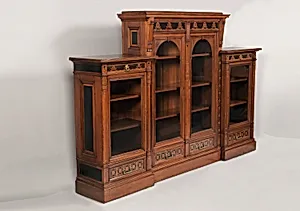
Tripartite bookcase with glass doors, the central section raised higher than the side two, all with matching sunflower-based inlaid motifs on a dark ground around the borders.
Art Historical Context
This elegant tripartite bookcase, by the renowned Herter Brothers firm of New York around 1875, exemplifies the opulence of Gilded Age American furniture. Featuring glass doors on three sections—the central one rising higher than the flanking sides—it boasts intricate sunflower-based inlaid motifs framed against a dark ground. These delicate marquetry details highlight the firm's mastery of mixed woods and fine cabinetry, blending functionality with lavish decoration for discerning 19th-century collectors. Herter Brothers, active from about 1865 to 1882, were leaders in the Aesthetic Movement, drawing from Renaissance Revival, Anglo-Japanese, and naturalist influences. Their pieces graced the homes of America's elite, including the Vanderbilt family, reflecting a post-Civil War boom in luxury goods that symbolized newfound wealth and cultural sophistication. The sunflower's bold, radiant form in the inlays evokes themes of growth and beauty prized in this era's decorative arts. Today, this bookcase graces the Smithsonian American Art Museum's collection, a gift from George P. Ververis, Jr. It invites us to appreciate how everyday objects became canvases for artistic innovation, bridging utility and high design in American history.