
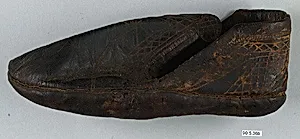
Boot
Unknown Artist
6th–7th century
Medium
Leather; incised
Dimensions
L. 9 11/16 in. (24.6 cm)
Classification
Leather
Department
Islamic Art
Museum
Metropolitan Museum of Art, New York, NY
Credit
Gift of George F. Baker, 1890
Accession Number
90.5.36b
Rights
Public Domain
Tags
Art Historical Context
Step into the world of early Islamic craftsmanship with this remarkable *Boot* from the 6th–7th century, rare survivor from the Metropolitan Museum of Art's Islamic Art collection. Craft from leather and meticulously incised—meaning designs were delicately carved into its surface—this humble footwear measures just 9 11/16 inches long. Donated in 1890 by George. Baker, it offers a tangible glimpse into daily life during a pivotal era bridging late antiquity and the dawn of Islam. Dating to the formative centuries of Islamic culture (roughly 622 CE onward), the boot likely originated from regions like the Arabian Peninsula or greater Middle East, where leatherworking was a vital craft. Such items were essential for travelers, traders, and nomads navigating vast deserts, highlighting the practicality and portability of early Islamic material culture. Its presence in the Islamic Art department underscores how everyday objects reveal the ingenuity of anonymous artisans. The incising technique exemplifies subtle artistry: thin lines etched into the leather create patterns that might evoke geometric motifs or protective symbols, common in Islamic decorative traditions even in functional pieces. Though worn by an unknown wearer, this boot preserves the tactile elegance of a bygone age, reminding us that beauty often hid in the soles of history.