
Bootjack
1935/1942
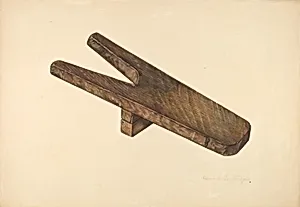
Medium
watercolor and graphite on paperboard
Dimensions
overall: 35.8 x 50.3 cm (14 1/8 x 19 13/16 in.) Original IAD Object: 14" long; 5" wide
Classification
Index of American Design
Department
CG-W
Museum
National Gallery of Art, Washington, D.C.
Credit
Index of American Design
Accession Number
1943.8.2030
Rights
Public Domain
Art Historical Context
**Bootjack** *Isabelle De Strange, 1935/1942* Watercolor and graphite on paper, 35.8 × 50.3 cm (14⅛ × 19⅞ in.) *Index of American Design, National Gallery of Art* Created by artist Isabelle Strange, *Bootjack* is a precise watercolor and graphite rendering from the Index of American Design, a landmark WPA Federal Art Project (1935–1942). During the Great Depression, this initiative employed hundreds of artists to document America's rich heritage of folk art, crafts, and design through detailed, life-sized illustrations. De Strange's work captures a humble wooden bootjack—an everyday tool measuring 14 inches long and 5 inches wide—elevating utilitarian objects into celebrated symbols of American ingenuity and craftsmanship. The bootjack, typically carved from a single piece of wood with a notched heel grip and V-shaped jaws, reflects 19th-century rural life, aiding farmers and workers in removing tight-fitting boots. By faithfully reproducing its form, grain, and wear, De Strange highlights the anonymous maker's skill and the object's cultural role in everyday American history. This medium—vibrant watercolor for color and texture, graphite for fine lines—allowed artists to convey three-dimensionality and patina on flat paperboard, preserving artifacts for posterity. Today, housed in the National Gallery of Art, *Bootjack* reminds us how the Index preserved vanishing traditions, fostering national pride in folk arts amid economic hardship. A testament to both artistic precision and historical insight, it invites visitors to appreciate the beauty in the practical.