
BK-1968-108
1784 - 1809
Medium
painting technique
Dimensions
20.5; 3.8
Rights
Public Domain
About this artwork
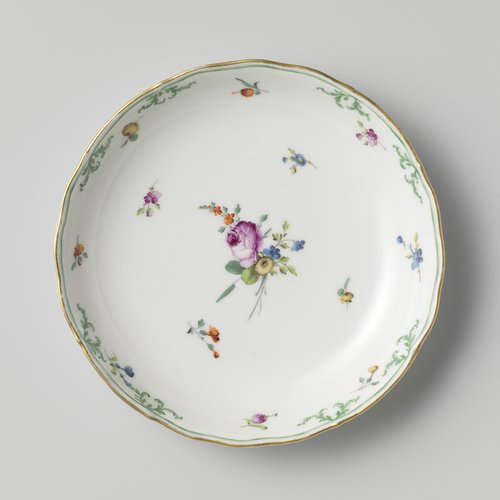
Bord met een licht gelobde rand. Op het plat een bloemboeket omgeven door strooibloemen. Langs de rand losse bladranken. Gemerkt: Amstel in onderglazuurblauw en ingegrift L48 met ster en N=5.
Art Historical Context
This delicate porcelain plate, titled *BK-1968-108*, hails from the esteemed Porceleinfabriek aan den Amstel, a Dutch porcelain factory in Amsterdam active from 1784 to 1809. Measuring just 3.8 cm in height and 20.5 cm in diameter, it the factory's specialty in finely crafted tableware during the late 18th and early 19th centuries The piece bears authentic marks—"Amstel" in underaze blue, along withised "L48" featuring a star and "N=5"—confirming its origin and likely serving as production or inventory notations from the era. At its center blooms a vibrant flower bouquet encircled by scattered blossoms (*strooibloemen*), with loose leafy tendrils gracefully framing the lightly lobed rim. This floral motif, rendered in a painting technique typical of European porcelain, draws from popular Rococo and Neoclassical influences, evoking the opulence of Dutch Golden Age still lifes adapted for everyday elegance. The underglaze decoration ensured colorfastness through firing, a hallmark of Amstel's high-quality soft-paste porcelain. Historically, the Amstel factory represented the Netherlands' ambitious foray into luxury porcelain production, rivaling imports from China and Meissen. Such plates graced affluent dining tables, blending artistry with utility and symbolizing prosperity amid the Enlightenment's taste for nature-inspired refinement. A charming survivor of this short-lived yet influential manufactory!