
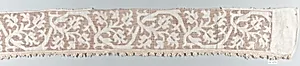
Border
Unknown Artist
16th century
Medium
Linen, drawnwork
Dimensions
L. 51 x W. 3 inches 129.5 x 7.6 cm
Classification
Textiles-Laces
Culture
Italian
Department
European Sculpture and Decorative Arts
Museum
Metropolitan Museum of Art, New York, NY
Credit
Gift of Margaret Taylor Johnstone, 1906
Accession Number
06.479
Rights
Public Domain
Art Historical Context
This exquisite linen border, crafted by an unknown Italian artist in the 16th century, exemplifies the delicate artistry of drawnwork—a technique where threads are meticulously drawn from the fabric and the remaining ones are stitched into intricate openwork patterns. Measuring 51 inches long and 3 inches wide, this narrow strip was likely designed as an edging for garments, linens, or ecclesiastical textiles, showcasing the period's obsession with refined ornamentation. In Renaissance Italy, particularly in lace-making hubs like Venice and Milan, drawnwork represented an early precursor to more complex needle laces, bridging embroidery and lacemaking traditions. Its geometric motifs and airy voids highlight the artisan's skill in creating light, translucent effects without cutting the cloth, a labor-intensive process that demanded patience and precision. Such pieces were status symbols, adorning the elite's wardrobes or enhancing altar cloths in churches. Now housed in the Metropolitan Museum of Art's European Sculpture and Decorative Arts Department—thanks to a 1906 gift from Margaret Taylor Johnstone—this border invites us to appreciate the unsung mastery of anonymous craftspeople, whose innovations laid the foundation for Europe's lace legacy.