
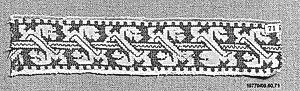
Border
Unknown Artist
16th–17th century
Medium
Drawnwork, linen and silk
Dimensions
L. 10 x W. 2 inches 25.4 x 5.1 cm
Classification
Textiles-Laces
Culture
Italian or Greek
Department
European Sculpture and Decorative Arts
Museum
Metropolitan Museum of Art, New York, NY
Credit
Rogers Fund, 1909
Accession Number
09.50.71
Rights
Public Domain
Art Historical Context
This delicate linen and silk border, crafted in the 16th or 17th century, exemplifies the exquisite drawnwork technique popular in Renaissance-era Europe. Drawnwork involves meticulously withdrawing threads from the fabric's ground weave and stitching the remaining yarns into intricate geometric patterns, creating a lacy effect without full bobbin or needlepoint lace. Measuring just 10 by 2 inches, this strip was likely designed as a trimming for garments, linens, or ecclesiastical vestments, showcasing the era's fascination with refined, translucent textiles. Attributed to an Italian or Greek artisan, the piece reflects the vibrant lace-making traditions of the Mediterranean. Italy, especially Venice and Milan, pioneered such techniques as precursors to elaborate bobbin laces, while Greek workshops on islands like Crete blended Byzantine influences with emerging Renaissance styles. Acquired through the Rogers Fund in 1909, it now resides in The Metropolitan Museum of Art's European Sculpture and Decorative Arts collection, highlighting the cultural exchange across trade routes. Visitors will appreciate how this modest artifact reveals the labor-intensive artistry of anonymous makers, whose skills adorned the elite and elevated everyday fabrics into treasures of historical elegance.