
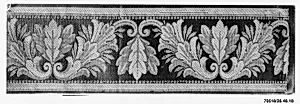
Border
Unknown Artist
19th century
Medium
Silk
Dimensions
11 1/4 x 3 3/8 inches (28.6 x 8.6 cm)
Classification
Textiles-Woven
Culture
French
Department
European Sculpture and Decorative Arts
Museum
Metropolitan Museum of Art, New York, NY
Credit
Gift of H. A. Elsberg, 1928
Accession Number
28.48.18
Rights
Public Domain
Art Historical Context
This exquisite silk border, crafted by an unknown French artist in the 19th century, exemplifies the refined artistry of European textile production. Measuring just 11¼ x 3⅜ inches (28.6 x 8.6 cm), this narrow woven strip was likely designed as a decorative trim for garments, furnishings, or upholstery, showcasing the versatility of silk as a luxurious medium. Its classification as a woven textile highlights the meticulous loom techniques of the era, where threads were interlaced to create durable yet delicate embellishments. In 19th-century France, silk weaving reached new heights of sophistication, particularly in regions like Lyon, fueling the opulent fashions and interiors of the Belle Époque. These borders served both functional and aesthetic purposes, adorning everything from dresses to curtains and symbolizing France's dominance in the global luxury textile trade. The piece's placement in the Metropolitan Museum of Art's Department of European Sculpture and Decorative Arts underscores its role in everyday elegance turned high art. Generously gifted to the Met in 1928 by H.A. Elsberg, this border invites us to appreciate the anonymous skill of its maker—a testament to the unsung heroes of decorative arts whose work adorned the lives of the elite.