
Border
Unknown Artist
17th century
Medium
Embroidered net, punto à rammendo
Dimensions
L. 108 x W. 11 inches 274.3 x 27.9 cm
Classification
Textiles-Laces
Culture
Italian, Sardinia
Department
European Sculpture and Decorative Arts
Museum
Metropolitan Museum of Art, New York, NY
Credit
The Mabel Metcalf Fahnestock Collection, the gift of Ruth Fahnestock Schermerhorn and Faith Fahnestock, 1933
Accession Number
33.90.3
Rights
Public Domain
Tags
Art Historical Context
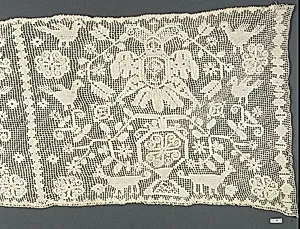
This exquisite 17th-century lace border from Sardinia, Italy, measures an impressive 108 inches long by 11 inches wide, showcasing the island's renowned tradition of fine needlework. Crafted as an embroidered net using the punto a rammendo technique—a meticulous method where artisans darn intricate patterns directly onto a mesh ground—this piece exemplifies the artistry of anonymous Italian lacemakers. Its delicate motifs of birds and flowers evoke the natural beauty of the Mediterranean, rendered with precision that highlights the era's emphasis on ornamental textiles for clothing, altar cloths, or household linens. Punto a rammendo, popular in Renaissance and Baroque Europe, allowed for bold, sculptural effects on a lightweight net, distinguishing it from woven laces. In Sardinia, such borders were often produced by skilled women in convents or villages, serving both practical and devotional purposes amid the Counter-Reformation's flourish of opulent church decorations. Now housed in the Metropolitan Museum of Art's European Sculpture and Decorative Arts Department, thanks to the Mabel Metcalf Fahnestock Collection (gifted in 1933), this border invites visitors to marvel at the unseen labor and cultural pride embedded in every stitch—a testament to 17th-century Sardinia's textile mastery.