
Border
Unknown Artist
16th century
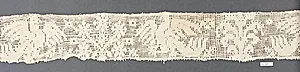
Medium
Embroidered net, buratto, punto à rammendo
Dimensions
L. 90 x W. 4 1/4 inches 228.6 x 10.8 cm
Classification
Textiles-Laces
Culture
Italian
Department
European Sculpture and Decorative Arts
Museum
Metropolitan Museum of Art, New York, NY
Credit
The Mabel Metcalf Fahnestock Collection, the gift of Ruth Fahnestock Schermerhorn and Faith Fahnestock, 1933
Accession Number
33.90.12
Rights
Public Domain
Tags
Art Historical Context
This delicate *Border* from 16th-century Italy exemplifies the artistry of Renaissance lacemaking, crafted by an unknown hand in embroidered net using buratto and punto à rendo techniques. Measuring an impressive 90 inches long by 4¼ inches wide (228.6 x 10.8 cm), this narrow strip was likely designed as an edging for garments, altar linens, or table, showcasing intricate motifs of birds that evoke the natural world with graceful precision. Buratto refers to a foundation of knotted net, meticulously filled with punto à rammendo—a darning stitch that weaves threads into geometric and organic patterns, creating a lightweight yet durable lace. In Renaissance Italy, particularly centers like Venice and Milan, such textiles were prized symbols of wealth and piety, blending technical virtuosity with decorative elegance. This piece highlights the era's fusion of craft and fine art, where lace rivaled painting in complexity. Now housed in the Metropolitan Museum of Art's Department of European Sculpture and Decorative Arts (Textiles-Laces), it entered the collection in 1933 as part of The Mabel Metcalf Fahnestock Collection, gifted by Ruth Fahnestock Schermerhorn and Faith Fahnestock. A testament to Italian cultural heritage, it invites visitors to appreciate the unseen labor and timeless beauty of historical needlework.