
Border
Unknown Artist
1650–1700
Medium
Needle lace
Dimensions
L. 172 x W. 7 inches 436.9 x 17.8 cm
Classification
Textiles-Laces
Culture
Italian, Venice
Department
European Sculpture and Decorative Arts
Museum
Metropolitan Museum of Art, New York, NY
Credit
The Mabel Metcalf Fahnestock Collection, the gift of Ruth Fahnestock Schermerhorn and Faith Fahnestock, 1933
Accession Number
33.90.40
Rights
Public Domain
Tags
Art Historical Context
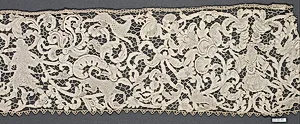
This exquisite needle lace border, crafted in Venice between 1650 and 1700, exemplifies the pinnacle of Baroque-era lace-making from one of Europe's premier textile centers. Measuring an impressive 172 inches long 7 inches wide, narrow strip was likely designed as an edging for grand altar frontals, tablecloths, or ecclesiastical vestments, where its intricate motifs of human figures and deer would added a touch of narrative elegance to opulent settings. Venetian needle lace, or *punto in aria*, was laboriously created stitch by stitch using a needle and thread, allowing artisans to sculpt three-dimensional floral scrolls, whimsical animals, and lively human scenes with unprecedented freedom and density. Unlike bobbin laces, this technique produced a robust, sculptural quality prized by nobility and the Church, symbolizing wealth and piety amid Venice's thriving maritime trade. Housed in The Metropolitan Museum of Art's European Sculpture and Decorative Arts collection, this anonymous masterpiece—gifted in 1933 from the Mabel Metcalf Fahnestock Collection—offers a glimpse into the anonymous genius of Venetian workshops. Its survival highlights the enduring allure of 17th-century decorative arts, blending artistry, devotion, and technical virtuosity.