
Border
Unknown Artist
18th century
Medium
Bobbin lace
Dimensions
L. 29 x W. 3 inches 73.7 x 7.6 cm
Classification
Textiles-Laces
Culture
Austrian
Department
European Sculpture and Decorative Arts
Museum
Metropolitan Museum of Art, New York, NY
Credit
The Mabel Metcalf Fahnestock Collection, the gift of Ruth Fahnestock Schermerhorn and Faith Fahnestock, 1933
Accession Number
33.90.182
Rights
Public Domain
Art Historical Context
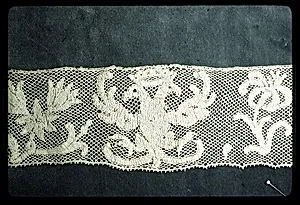
Step into the delicate world of 18th-century Austrian craftsmanship with *Border*, a stunning example of bobbin lace from Metropolitan Museum of Art's Sculpture and Decorative Arts collection. Measuring 29 inches long by 3 inches (73.7 x 7.6 cm), this strip was likely designed as an elegant edging for garments, linens, or, showcasing the era's obsession with intricate ornamentation. Bobbin lace, a prized technique originating in Europe, involves twisting and intertwining fine threads held on handheld bobbins over a patterned pillow. In 18th-century Austria, this labor-intensive art flourished amid the Baroque and Rococo styles, where lace symbolized wealth and status. Anonymous artisans—often women in specialized workshops—created these pieces with pins marking the design, producing airy, symmetrical motifs that demanded patience and precision. Today, *Border* reflects the cultural prestige of Austrian textiles, preserved through The Mabel Metcalf Fahnestock Collection and gifted to the Met in 1933 by Ruth Fahnestock Schermerhorn and Faith Fahnestock. It invites us to appreciate the unseen hands behind Europe's golden age of lace, blending utility with exquisite artistry.