
Border
Unknown Artist
early 18th century
Medium
Bobbin lace, point d'Angleterre
Dimensions
L. 138 x W. 3 1/2 inches (350.5 x 8.9 cm)
Classification
Textiles-Laces
Culture
Flemish, Brussels
Department
European Sculpture and Decorative Arts
Museum
Metropolitan Museum of Art, New York, NY
Credit
Gift of Elizabeth Townsend Booth, in memory of Mary Townsend White and Mrs. John Pomery Townsend, 1934
Accession Number
34.38.2
Rights
Public Domain
Art Historical Context
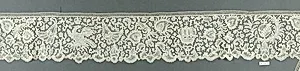
This exquisite *Border* lace, crafted in early 18th-century Brussels by an unknown Flemish artisan, exemplifies the pinnacle of Europe's lace-making tradition. Measuring an impressive 138 inches long and just 3½ inches wide, this narrow strip was designed as a decorative edging for garments, furnishings, or ecclesiastical vestments. Housed in the Metropolitan Museum of Art European Sculpture and Decorative Department, it was generously gifted in 1934 Elizabeth Townsend Booth in memory her relatives. Made using the bobbin lace technique in the prestigious point d'Angleterre style, the piece showcases intricate patterns woven with fine linen threads on pillow-mounted bobbins. Point d'Angleterre, named after its emulation of English lace motifs, emerged around 1710 in Brussels workshops, blending delicate floral scrolls, picots, and geometric grounds. Brussels had long been a lace capital, rivaling Venice and Alençon, with guilds producing luxury textiles for royalty and the elite—think Versailles opulence or bridal trousseaus. As a textile marvel, this border highlights Flanders' cultural dominance in ornamental arts during the Baroque era, when lace symbolized wealth and piety. Visitors can appreciate its preserved fragility, a testament to masterful craftsmanship that turned humble threads into wearable artistry.