
Border
Unknown Artist
late 17th–early 18th century
Medium
Needle lace
Dimensions
L. 131 1/2 x W. 11 1/2 inches (334.0 x 29.2 cm)
Classification
Textiles-Laces
Culture
Italian, Venice
Department
European Sculpture and Decorative Arts
Museum
Metropolitan Museum of Art, New York, NY
Credit
Gift of Mrs. George Nichols, from the collection of her mother, Mrs. J.P. Morgan (1868-1925), 1938
Accession Number
38.19.4
Rights
Public Domain
Tags
Art Historical Context
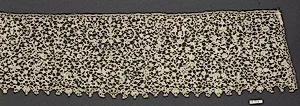
This exquisite *Border* from late 17th- to early 18th-century Venice showcases the pinnacle of Italian needle lace craftsmanship. Measuring an impressive 131½ inches long and just 11½ inches wide, this narrow strip was likely designed as an edging for luxurious textiles like altar cloths, table linens, or ecclesiastical vestments. Crafted in the renowned Venetian tradition, it features delicate floral motifs—evident from its tagging—stitched with fine linen threads to create airy, three-dimensional patterns that seem to float ethereally. Needle lace, or *punto in aria* ("point in air"), was a virtuoso technique where lacemakers built intricate designs stitch by stitch without a supporting ground fabric. Venice dominated this art form during the Baroque era, exporting lace to Europe's elite courts as a symbol of opulence and piety. The labor-intensive process could take months for a piece of this scale, highlighting the anonymous artisans' skill in rendering lifelike flowers with shadowy depths and textured blooms. Housed in The Metropolitan Museum of Art's European Sculpture and Decorative Arts collection, this border—gifted from the J.P. Morgan family—offers a glimpse into Venice's golden age of lace, blending artistry, devotion, and commerce. Visitors can marvel at how such fragile finery once adorned sacred spaces, preserving a tactile legacy of Renaissance innovation into the Rococo dawn.