
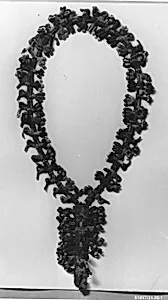
Border Fragment
Unknown Artist
2nd century BCE
Medium
Camelid hair, cotton
Dimensions
W. 10 x L.17 3/4 in. (25.4 x 45.09 cm)
Classification
Textiles-Woven
Culture
Nasca
Department
Arts of Africa, Oceania, and the Americas
Museum
Metropolitan Museum of Art, New York, NY
Credit
Gift of George D. Pratt, 1931
Accession Number
31.20.1
Rights
Public Domain
Art Historical Context
This exquisite *Border Fragment* from theca culture of ancient Peru, dating to the 2nd century BCE, a glimpse into one of the Americas' earliest masterworks of textile artistry. The Nasca people, flourishing in the arid south coast region from around 100 BCE to800 CE, were renowned for their sophisticated weaving traditions, which rivaled their famous geoglyphs (the Nazca Lines) in complexity and cultural depth. This small yet intricate piece, measuring just 10 by 17¾ inches, likely edged a larger garment, mantle, or ceremonial cloth, highlighting textiles' role in daily life, status, and ritual. Crafted from camelid hair—probably from alpacas or vicuñas—and cotton, the fragment showcases the Nasca's innovative weaving techniques. They expertly combined these fibers for durability and vibrant color potential, employing tapestry weaves or supplementary weft patterns typical of Andean textiles. Natural dyes derived from plants, insects, and minerals would have produced the bold motifs often seen in Nasca work, though this border's precise designs evoke the culture's fascination with mythical creatures, felines, and geometric forms symbolizing fertility, power, and the cosmos. Today, housed in the Metropolitan Museum of Art's Department of the Arts of Africa, Oceania, and the Americas (gift of George D. Pratt, 1931), this artifact underscores the Nasca's technological prowess and aesthetic brilliance, bridging the Pre-Columbian world to modern admirers. It's a testament to how ancient weavers transformed humble fibers into enduring stories of their world.