
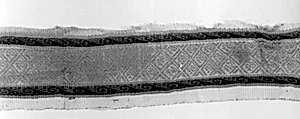
Border fragment
1000-1476
Medium
Fancy compound cloth. Warp: s-spun tightly twisted; s-spun, two, ply, all cotton. Weft: cotton in pairs; one s-spun and one z-spun.
Dimensions
113 × 11.4 cm (44 1/2 × 4 1/2 in.)
Classification
textile
Department
Textiles
Museum
Art Institute of Chicago
Accession Number
85239
Rights
Public Domain
Art Historical Context
This exquisite *Border fragment* from Huacho, Peru, dates to the Late Intermediate Period (1000–1476 CE), a time when coastal Andean cultures like the Chancay flourished. Likely produced in the Chancay region near modern Lima, these textiles were masterful expressions of pre-Columbian weaving artistry. At 113 × 11.4 cm, this narrow strip would have adorned the edges of garments,les, or ceremonial cloths, showcasing the society's reverence for fine craftsmanship. Crafted in "fancy compound cloth"— sophisticated technique using all-cotton yarns—the warp features tightly twisted s-spun threads, some two-ply for strength, while the weft alternates pairs of s-spun and z-spun cotton. This intricate pairing allowed weavers to create supplementary patterns, producing vibrant motifs of geometric designs, mythical birds, or marine life typical of Chancay style. Such methods demanded exceptional skill on backstrap looms, highlighting women's pivotal role as textile experts in Andean communities. Housed in the Art Institute of Chicago's Textiles Department, this fragment reveals the cultural prestige of textiles in pre-Inca Peru, often buried with elites as offerings to the afterlife. Its preservation offers a tactile glimpse into a world where cloth rivaled gold in value, blending utility, spirituality, and aesthetic brilliance.