
Border Fragment
100 BCE-200 CE
Medium
Cotton, plain weave; embroidered with wool (camelid) in stem stitches
Dimensions
39.4 × 20.3 cm (15 1/2 × 8 in.)
Classification
textile
Department
Textiles
Museum
Art Institute of Chicago
Accession Number
9386
Rights
Public Domain
About this artwork
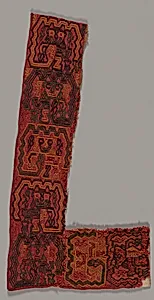
The distinctive stylized figure depicted on this fragment has wide eyes and an upturned mouth, with streamers or appendages trailing from its body. Scholars have named this figure the “oculate being” because of its wide eyes. However, it remains a matter of debate whether the figure represents a particular supernatural entity or a stylized figural representation.
Art Historical Context
This exquisite *Border Fragment* hails from the Paracas culture of ancient Peru, flourishing between 100 BCE and 200 CE during the Early Period. The Paracas people, named after the peninsula near their Necropolis site, were masterful weavers whose textiles often adorned elite burials, wrapping mummies in vibrant mantles and garments. This yet intricate piece (39.4 × 20.3 cm) likely served as an ornamental edge for a larger shroud or clothing item, showcasing the culture's reverence for elaborate decoration in daily and ritual life. Crafted on a cotton plain-weave foundation, the fragment is embroidered with fine camelid wool—sourced from alpacas or vicuñas—using precise stem stitches. This technique allowed for bold, continuous lines and dense patterns, creating a luxurious texture prized for its durability and colorfastness. Camelid wool's natural sheen and strength made it ideal for Peru's arid coastal environment, where textiles survived remarkably well in dry tombs. Housed in the Art Institute of Chicago's Textiles Department, this fragment exemplifies Paracas artistry's influence on later Andean traditions, like those of the Nazca and Inca. Its survival offers a window into pre-Columbian ingenuity, blending functionality with spiritual symbolism in every stitch.