
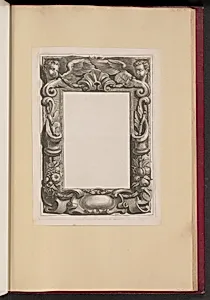
Border Illustration with Two Putti and Fruit
1613/1646
Medium
engraving on laid paper [proof before letters]
Classification
Department
CG-E
Museum
National Gallery of Art, Washington, D.C.
Credit
William B. O'Neal Fund
Accession Number
1996.78.44
Rights
Public Domain
Art Historical Context
**Border Illustration with Two Put and Fruit** Cornelis Galle I, a Flemish engraver active in Antwerp during the early Baroque era, created this enchanting border design around 1613, with possible later impressions up to 1646. Galle, known for his intricate reproductive prints after Peter Paul Rubens and other leading artists, captures two playful putti—cherubic figures symbolizing joy and abundance—frolicking amid lush fruit. These motifs evoke the opulent still-life traditions of the Dutch and Flemish Golden Age, where fruit often represented prosperity and the fleeting pleasures of life. Rendered as an engraving on laid paper, this rare *proof before letters* offers a glimpse into the printmaking process before final lettering or titles were added. Galle's technique shines in the fine, fluid lines etched into a metal plate, allowing ink to cling to the grooves for rich tonal depth and exquisite detail. Such proofs were prized by collectors for their purity, revealing the artist's hand unadorned. Housed in the National Gallery of Art through the William B. O'Neal Fund (Department CG-E), this print exemplifies the Baroque delight in decorative exuberance. It likely served as an ornamental border for books, frames, or tapestries, bridging fine art and everyday luxury in 17th-century Europe. Visitors, imagine these cherubs framing your own treasured volume!