
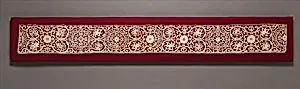
Border of needle lace
Unknown Artist
early 17th century
Medium
Linen needle lace
Dimensions
L. 40 1/4 x W. 4 1/4 inches (102.2 x 10.8 cm)
Classification
Textiles-Laces
Culture
Italian
Department
European Sculpture and Decorative Arts
Museum
Metropolitan Museum of Art, New York, NY
Credit
The Mabel Metcalf Fahnestock Collection, the gift of Ruth Fahnestock Schermerhorn and Faith Fahnestock, 1933
Accession Number
33.90.29
Rights
Public Domain
Art Historical Context
This delicate *Border of needle lace*, crafted in early 17th-century Italy exemplifies the pinnacle of Renaissance-era textile artistry. Measuring over three feet long and just over four inches wide, this linen piece was likely designed as an edging for garments, linens, or ecclesiastical vestments—status symbols among Europe's elite. Italian lace, particularly from Venice, was prized across the continent for its translucency and intricacy, rivaling gold and jewels in value during the Baroque period's opulent courts. Needle lace, or *punto in aria* ("stitch in air"), represents a virtuoso technique where artisans built motifs stitch by stitch directly onto a temporary paper pattern, using a single needle and thread. Without a loom or bobbin support, the linen threads form a self-sustaining web of floral scrolls, picots, and openwork voids—each element requiring hours of painstaking precision. This method allowed for unprecedented freedom in design, transforming humble flax into ethereal filigree. Housed in The Metropolitan Museum of Art's European Sculpture and Decorative Arts Department, this border entered the collection in 1933 through the generous gift of the Mabel Metcalf Fahnestock Collection. It invites us to marvel at the anonymous hands behind such finery, a testament to Italy's enduring legacy in decorative arts.