
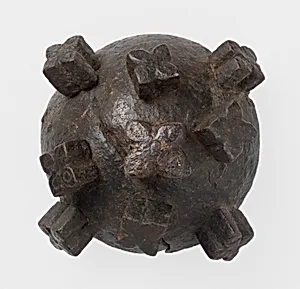
Boss and Nail
Unknown Artist
15th–16th century
Medium
Iron
Dimensions
Overall: 3 5/8 x 8 in. (9.2 x 20.3 cm)
Classification
Metalwork-Iron
Culture
European
Department
The Cloisters
Museum
Metropolitan Museum of Art, New York, NY
Credit
The Cloisters Collection, 1955
Accession Number
55.61.117a, b
Rights
Public Domain
Art Historical Context
Nestled in The Cloisters' collection at the Metropolitan Museum of Art *Boss and Nail* is modest yet masterful example of 15th–16th European ironwork. Crafted from durable iron, this small piece—measuring just 3 5/8 x 8 inches—likely served as a functional element in everyday medieval life, such as a decorative boss (a raised, rounded ornament) paired with a sturdy nail for securing wooden doors, chests, or furniture panels. Its unadorned form highlights the practicality of iron as a medium, prized for its strength and malleability in an era before widespread steel production. Forged by an unknown artisan, the object showcases the blacksmith's skill in hand-hammering and shaping red-hot iron over an anvil—a labor-intensive technique central to late medieval and early Renaissance metalwork. These tools of trade were essential in European households and architecture, blending utility with subtle artistry through textured surfaces and precise proportions that ensured both reinforcement and aesthetic appeal. Today, *Boss and Nail* invites us to appreciate the anonymous makers whose work underpinned daily existence. Acquired in 1955 as part of The Cloisters Collection, it reminds visitors of the unsung beauty in functional design, bridging the gap between craftsmanship and cultural history in medieval Europe.