
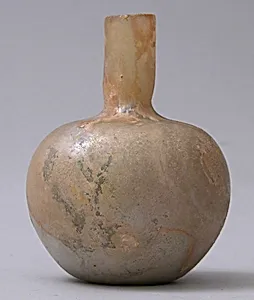
Bottle
Unknown Artist
8th–9th century
Medium
Glass; free blown; tooled on the pontil
Dimensions
H. 3 1/8 in. (7.9 cm) Diam. ca. 2 3/8 in. (6 cm)
Classification
Glass
Department
Islamic Art
Museum
Metropolitan Museum of Art, New York, NY
Credit
Gift of Henry G. Marquand, 1881
Accession Number
81.10.287
Rights
Public Domain
Art Historical Context
This delicate glass bottle, dating to the 8th–9th century, hails from the vibrant world of Islamic art, where artisans crafted everyday objects into exquisite works of beauty. Standing just over 3 inches tall with a diameter of about 2⅜ inches, its petite size suggests it once held precious perfumes, oils, or spices—luxuries that symbolized refinement in Abbasid-era households across the Middle East and beyond. Now housed in the Metropolitan Museum of Art's of Islamic Art, it was generously gifted by Henry G. Marquand in 1881, preserving a glimpse of medieval ingenuity. Crafted using free-blown glass—a revolutionary technique involving blowing molten glass through a tube to form shapes—the bottle showcases the skill of anonymous Islamic glassmakers. They refined this Roman-era method, achieving thin, lightweight vessels with remarkable clarity and strength. The base was tooled on the pontil, an iron rod that allowed precise finishing, often leaving a characteristic scar that speaks to hands-on mastery. During this golden age of Islamic craftsmanship, such bottles were mass-produced yet artistically elevated, reflecting cultural values of elegance and functionality. Though simple in form, this bottle embodies the Islamic world's leadership in glass innovation, influencing trade routes from Syria to Spain. Visitors, picture it glinting in lamplight, a testament to artisans whose techniques endure in modern glassblowing today.