
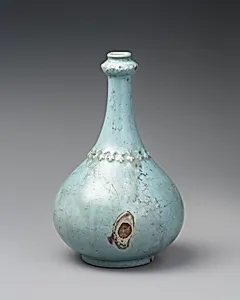
Bottle
Unknown Artist
17th–18th century
Medium
Earthenware; glazed
Dimensions
Ht. 7 3/4 in. (19.7 cm) Diam. 5 1/16 in. (12.8 cm)
Classification
Ceramics
Department
Islamic Art
Museum
Metropolitan Museum of Art, New York, NY
Credit
Edward C. Moore Collection, Bequest of Edward C. Moore, 1891
Accession Number
91.1.142
Rights
Public Domain
Art Historical Context
This elegant earthenware bottle, crafted by an unknown artist in the th or 18th century, the refined ceramics of the Islamic world. Standing just 7¾ inches tall with a diameter of 5⅛ inches, its modest scale suggests it served practical purposes—perhaps for storing oils, perfumes, or spices—while doubling as a decorative household object. Housed in the Metropolitan Museum of Art's Art Department, it entered the collection in 1891 through the bequest of Edward C., a pioneering collector of global antiquities. The use of glazed earthenware highlights a hallmark technique in Islamic pottery production, where a vitreous glaze sealed the porous clay body, making it impermeable and ideal for liquids. This method, widespread across regions like Persia, the Ottoman Empire, and North Africa during this era, allowed artisans to create smooth, lustrous surfaces that elevated everyday vessels into works of subtle artistry. Though unattributed, such bottles reflect the period's emphasis on functional beauty, blending utility with cultural refinement. Today, this unassuming piece invites us to appreciate the anonymous makers whose innovations in glazing influenced ceramics far beyond their time, offering a tangible link to vibrant Islamic traditions.