
Bottle
Unknown Artist
probably 18th–19th century
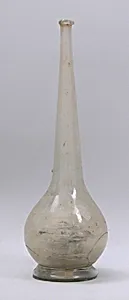
Medium
Glass; free blown, applied decoration; tooled on the pontil
Dimensions
H. 11 3/4 in. (29.8 cm) Max. Diam. 3 7/8 in. (9.9 cm)
Classification
Glass
Department
Islamic Art
Museum
Metropolitan Museum of Art, New York, NY
Credit
Edward C. Moore Collection, Bequest of Edward C. Moore, 1891
Accession Number
91.1.1551
Rights
Public Domain
Art Historical Context
This elegant glass bottle, likely crafted in the 18th or 19th century, hails from the Islamic world and exemplifies the refined artistry of the period. Standing at 11¾ inches tall with a slender profile (maximum diameter 3⅞ inches), it was designed for practical yet decorative purposes—perhaps to hold perfumes, oils, or rosewater, staples in Ottoman, Persian, or Levantine households. Its presence in the Metropolitan Museum of Art's Islamic department highlights the region's enduring legacy in glassmaking, where translucent vessels like this symbolized luxury and hospitality. The bottle's creation showcases masterful free-blown techniques, where molten glass was skillfully inflated by mouth into its graceful shape without a mold, allowing for fluid, organic forms. Applied decoration—trails or threads of glass meticulously added while hot—adds tactile elegance, while the tooled pontil mark (a remnant of the iron rod used in blowing) reveals handcrafted authenticity. These methods, perfected over centuries in Islamic workshops from Syria to India, prioritized both functionality and subtle beauty over opulent enameling seen in earlier eras. A gem from the Edward C. Moore Collection, bequeathed to the Met in 1891, this anonymous masterpiece invites us to appreciate the anonymous artisans whose innovations influenced global glass traditions.