
Bottle
Unknown Artist
probably 18th–19th century
Medium
Glass; free blown, tooled on the pontil
Dimensions
Ht. 8 3/4in. (22.2cm) Max Diam. 3 3/4 in. (9.6 cm)
Classification
Glass
Department
Islamic Art
Museum
Metropolitan Museum of Art, New York, NY
Credit
Edward C. Moore Collection, Bequest of Edward C. Moore, 1891
Accession Number
91.1.1569
Rights
Public Domain
Art Historical Context
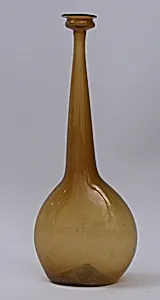
This elegant glass bottle, likely crafted in the 18th or 19th century, the refined artistry of Islamic glassmaking. Standing at 8 3/4 inches tall with a maximum diameter of 3/4 inches, it was created using the free-blown technique, where molten glass is gathered on a blowpipe and shaped by inflation and gravity alone, without molds. The base bears a tooled pontil mark, of the artisan's skill in finishing the vessel directly on the iron rod used during blowing. Such methods, perfected in the Islamic world from medieval times onward, allowed for graceful, asymmetrical forms prized for both utility and beauty. In the Department of Islamic Art at The Metropolitan Museum of Art, this bottle reflects the enduring tradition of glass production in regions like the Ottoman Empire, Syria, or Egypt, where transparent vessels held perfumes, rosewater, oils, or medicinals. These objects were not mere containers but symbols of luxury and technical mastery, often evoking the luminous quality of mosque lamps or palace decanters from earlier eras. Though the artist remains unknown, the bottle's simple yet sophisticated profile highlights the anonymous craft guilds that sustained this vibrant medium. Part of the Edward C. Moore Collection, bequeathed to the Met in 1891, it invites us to appreciate the subtle elegance of everyday Islamic luxury—timeless in its clarity and form. (198 words)