
Bottle
Unknown Artist
probably 18th–19th century
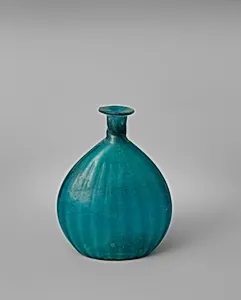
Medium
Glass; mold blown, tooled on the pontil
Dimensions
H. 5 1/8 in. (13 cm) W. 2 1/4 in. (5.7 cm) Max. Diam. 3 7/8 in. (9.9 cm)
Classification
Glass
Department
Islamic Art
Museum
Metropolitan Museum of Art, New York, NY
Credit
Edward C. Moore Collection, Bequest of Edward C. Moore, 1891
Accession Number
91.1.1572
Rights
Public Domain
Art Historical Context
This delicate glass bottle, likely from the 18th 19th century, the refined craftsmanship of Islamic art. Standing just over 5 inches tall with a slender profile—2¼ inches wide and up to 3⅞ inches in diameter—it was probably used to hold perfumes, oils, or spices everyday luxuries in Ottoman or Persian households. Such vessels highlight the Islamic world's mastery of glassmaking, a tradition dating back centuries, where translucent forms symbolized purity and abundance. Crafted using mold-blowing and tooling on the pontil, the bottle reveals sophisticated techniques. Glass was blown into a mold to create subtle patterns or textures, then tooled—shaped and finished—directly on the pontil rod, the iron pipe used by artisans to manipulate molten glass. This method, evident in the characteristic pontil scar on the base, allowed for precise, lightweight forms that were both functional and elegant, often without heavy decoration to emphasize the material's clarity. Part of the Metropolitan Museum of Art's Edward C. Moore Collection (bequeathed in 1891), this anonymous masterpiece invites us to appreciate the unsung artisans of Islamic culture, whose innovations influenced global glass production. A testament to enduring beauty in utility, it whispers of bustling bazaars and scented seraglios long past.