
Bottle
Unknown Artist
7th–8th century
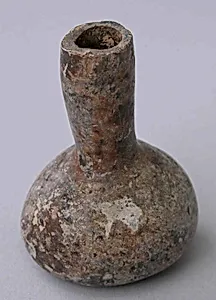
Medium
Glass; blown, tooled on the pontil
Dimensions
H. 1 11/16 in. (4.3 cm) Diam. 1 1/4 in. (3.2 cm)
Classification
Glass
Department
Islamic Art
Museum
Metropolitan Museum of Art, New York, NY
Credit
Rogers Fund, 1932
Accession Number
32.150.137
Rights
Public Domain
Art Historical Context
This delicate glass bottle, crafted by an unknown artist in the 7–8th century, the early mastery of glassmaking in the Islamic world during the Umayyad or early Abbasid periods. Standing just 1 11/16 inches tall and 1 1/4 inches in diameter its petite scale suggests it was likely used hold precious perfumes, oils, or spices—luxuries prized in medieval Islamic societies for personal adornment and trade. The bottle was created using free-blown glass techniques, a revolutionary method perfected in the Syrian-Palestinian region around this time, where molten glass was inflated on a blowpipe into fluid, lightweight forms. It was then tooled on the pontil—a metal rod used to shape the base—leaving a characteristic rough mark that speaks to the artisan's hands-on skill. This process allowed for affordable, mass-producible yet elegantly simple vessels, contrasting with earlier Roman casting methods and highlighting Islamic innovation in everyday luxury goods. Housed in the Metropolitan Museum of Art's Islamic Art Department (acquired via the Rogers Fund in 1932), this unadorned bottle reflects the era's focus on transparency and form over decoration, inviting us to appreciate the subtle beauty of functional art that bridged cultures along ancient trade routes.