
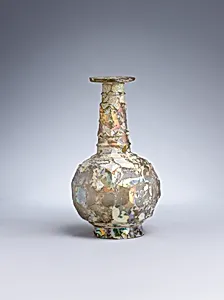
Bottle
Unknown Artist
9th–10th century
Medium
Glass, colorless with yellowish tinge; blown, cut
Dimensions
H. 6 1/2 in. (16 .5cm) Max.diam. 3 5/8 in. (9.2 cm)
Classification
Glass
Department
Islamic Art
Museum
Metropolitan Museum of Art, New York, NY
Credit
Harris Brisbane Dick Fund, 1963
Accession Number
63.159.5
Rights
Public Domain
Art Historical Context
This elegant glass bottle, dating to the 9th–10th century, hails from the Islamic world and exemplifies the exquisite craftsmanship of early medieval glassmakers. Standing just 6 1/2 inches tall a maximum diameter of 3 5/8 inches, its colorless form with a subtle yellowish tinge was meticulously blown and then adorned with precise cuts, creating a delicate, translucent beauty. Housed in the Metropolitan Museum Art's Islamic Art department it was acquired through the Harris Brisbane Dick Fund in 1963. Blown glass technique, perfected in the Islamic realms during this era, allowed for thin-walled vessels that were both functional and artistic, revolutionizing glass production from earlier molding methods. The added cutting—likely geometric patterns etched into the surface—highlights the artisans' mastery, transforming a simple storage bottle into a coveted object. Such pieces were common in households across the Abbasid Caliphate, from Syria to Egypt, blending utility with refined aesthetics. In Islamic culture, everyday items like this bottle reflected a deep appreciation for transparency and light play, symbolizing purity and abundance. Though the artist remains unknown, this survivor offers a window into a golden age of innovation, where glassware rivaled precious metals in prestige.