
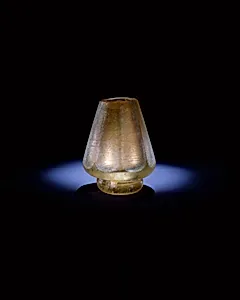
Bottle
Unknown Artist
9th–10th century
Medium
Glass; blown, cut; tooled on the pontil
Dimensions
H. 2 3/4 in. (7 cm) Max. Diam 2 3/16 in. ( 5.5 cm)
Classification
Glass
Department
Islamic Art
Museum
Metropolitan Museum of Art, New York, NY
Credit
Gift of Marilyn Jenkins, in memory of her father, Dr. Arthur M. Jenkins, 1982
Accession Number
1982.478.7
Rights
Public Domain
Art Historical Context
This delicate glass bottle, crafted by an unknown artisan in the 9th–10th century, exemplifies exquisite glassmaking traditions of the Islamic world during the Abbasid era. Standing just 2¾ inches tall with a maximum diameter of 2⅛ inches, it was likely used to hold precious oils, perfumes, or spices—common luxuries in medieval Islamic society. Its small scale belies the sophistication of its creation, now housed in the Metropolitan Museum of Art Department of Islamic Art. The bottle was made using advanced techniques: glass was blown into shape, then meticulously cut for decoration and tooled on the pontil—a pontil rod used to hold and finish the base during cooling, leaving a distinctive mark. Islamic glassworkers, centered in regions like Syria and Iraq, perfected blown glass after its Roman origins, elevating everyday vessels into objects of beauty through precise cutting that could create intricate patterns, though this example's surface speaks to the era's focus on clarity and form. Such bottles highlight the Islamic Golden Age's technological prowess and cultural refinement, where glass production fueled trade across Eurasia. Donated in 1982 in memory of Dr. Arthur M. Jenkins, this piece invites us to appreciate how anonymous craftspeople transformed sand into enduring art, bridging utility and elegance.