
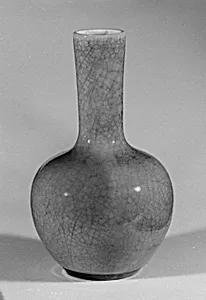
Bottle
Unknown Artist
18th century
Medium
Porcelain with stonegray slip under bluish-green crackled glaze; transparent green glaze all over
Dimensions
H. 6 9/16 in. (16.7 cm); Diam. 4 in. (10.2 cm)
Classification
Ceramics
Culture & Period
China · Qing dynasty (1644–1911)
Department
Asian Art
Museum
Metropolitan Museum of Art, New York, NY
Credit
Gift of Edwin C. Vogel, 1966
Accession Number
66.206.13
Rights
Public Domain
Art Historical Context
This elegant porcelain bottle from 18th-century China, crafted during the Qing dynasty (4–1911), the era's masterful ceramic artistry. Standing at just over 6½ inches tall with a 4-inch diameter its compact form suggests it may have served as a snuff bottle, inkwell, or decorative vessel, blending utility with refined beauty. Housed in the Metropolitan Museum of Art's Asian Department as a gift from Edwin C. in 1966, it captures the sophistication of imperial porcelain production, likely from kilns in Jingdezhen, the world's porcelain capital. The bottle's medium is a technical marvel: fine porcelain body coated with stonegray slip beneath a bluish-green crackled glaze, finished in a transparent green layer overall. The crackle effect—tiny fissures in the glaze formed during cooling—was a deliberate aesthetic choice, evoking ice patterns on ancient jade or winter landscapes, prized in Chinese ceramics for its organic, aged patina. This celadon-inspired green hue nods to Song dynasty traditions revived in the Qing, showcasing glazers' precision in controlling firing temperatures for such luminous, translucent results. In Qing China, such bottles reflected the dynasty's prosperity and export trade, adorning scholarly desks or elite collections worldwide. Though by an unknown artist, its enduring appeal lies in the anonymous craft of potters who elevated everyday objects into timeless art, inviting visitors to ponder the hands that shaped its serene glow.