
Bottle
Unknown Artist
1700–1800
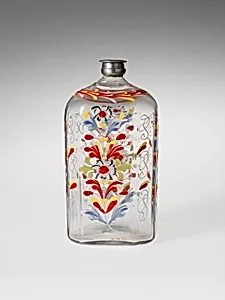
Medium
Non-lead glass with enamel decoration
Dimensions
H. 7 1/4 in. (18.4 cm)
Classification
Bottle
Department
The American Wing
Museum
Metropolitan Museum of Art, New York, NY
Credit
Gift of Frederick W. Hunter, 1913
Accession Number
13.179.70a
Rights
Public Domain
Tags
Art Historical Context
This elegant bottle, crafted from non-lead glass with vibrant enamel decoration between 1700 and 1800, exemplifies early American glassmaking ingenuity. Standing at just 7¼ inches tall, its slender form and floral motifs—likely rendered in colorful enamels fired onto the surface—transform a utilitarian object into a decorative treasure. Housed in The Metropolitan Museum of Art's American Wing, it was generously gifted by Frederick W. Hunter in 1913. Non-lead glass was a hallmark of colonial and early federal American production, as imported lead crystal from Europe was costly and scarce. Artisans relied on local silica sands and basic fluxes, achieving a clear yet sturdy material ideal for household wares. The enamel technique, involving powdered glass colors painted and fused in a kiln, added luminosity and durability, often featuring popular motifs like flowers that evoked the natural beauty of the New World. Such bottles held perfumes, oils, or medicines in prosperous homes, blending functionality with folk artistry. Today, it offers a glimpse into 18th-century American craftsmanship, highlighting how everyday items reflected cultural aspirations amid growing independence from European imports.