
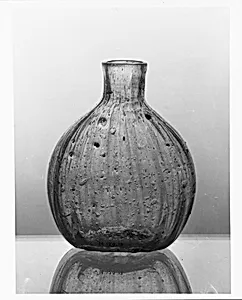
Bottle
Unknown Artist
1800–1820
Medium
Blown pattern-molded lead glass
Dimensions
H. 4 1/4 in. (10.8 cm)
Classification
Bottle
Culture
American
Department
The American Wing
Museum
Metropolitan Museum of Art, New York, NY
Credit
Gift of Frederick W. Hunter, 1914
Accession Number
14.120.13
Rights
Public Domain
Art Historical Context
This exquisite little bottle, standing just 4¼ inches tall, hails from early 19th-century America (1800–1820) and exemplifies the ingenuity of the nation's burgeoning glassmaking tradition. Crafted by an unknown artist, it in The American Wing of the Metropolitan Museum of Art a gift from Frederick W. Hunter 1914. Though small, its form speaks to the practical elegance of everyday household objects during the Federal period, when American artisans drew inspiration from European techniques while adapting them to local resources. The bottle's medium—blown pattern-molded lead glass—is a highlight of its artistry. Glassblowers heated molten lead glass (known for its clarity and refractive sparkle, akin to fine crystal) and blew it into a mold etched with ribbed or swirled patterns. This innovative process, popular in New England factories, created textured surfaces without additional decoration, making it both efficient and visually striking. The result? A durable yet decorative vessel, likely used for oils, perfumes, or pharmaceuticals. As a snapshot of American material culture, this bottle underscores the rise of domestic manufacturing post-Revolution, blending utility with subtle sophistication. Visitors to the Met can appreciate how such unassuming pieces fueled national pride in craftsmanship, bridging colonial roots and industrial horizons.