
Bottle Neck
Unknown Artist
10th–11th century
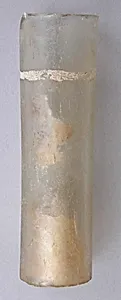
Medium
Glass; free blown
Dimensions
H. 3 1/4 in. (8.3 cm); Diam. 15/16 in. (2.4 cm)
Classification
Glass
Department
Islamic Art
Museum
Metropolitan Museum of Art, New York, NY
Credit
Harris Brisbane Dick Fund, 1964
Accession Number
64.133.1b
Rights
Public Domain
Art Historical Context
This delicate glass fragment, known as *Bottle Neck*, hails from the Islamic world of the 10th–11th century. Standing just 3¼ inches tall with a slender diameter of 15/16 inch, it represents the neck of a small bottle, likely used for precious oils, perfumes, or medicines—common luxuries in medieval Islamic households. Crafted by an unknown artisan, its petite scale highlights the everyday elegance of Islamic material culture, where even utilitarian objects embodied refined craftsmanship. The piece exemplifies free-blown glass, a revolutionary technique perfected by Islamic glassmakers during the early medieval period. Molten glass was gathered on a blowpipe and inflated with a puff of air, allowing for fluid, organic shapes without molds. This method, adopted from Roman traditions but elevated in the Islamic Near East and beyond, enabled mass production of intricate vessels while preserving transparency and thin walls. Over centuries, such glass often developed a shimmering iridescence from natural weathering, adding to its allure. Housed in the Metropolitan Museum of Art's Islamic Art Department (acquired via the Harris Brisbane Dick Fund in 1964), *Bottle Neck* offers a tangible glimpse into a golden age of innovation. It underscores how Islamic artisans transformed humble sand, soda, and lime into objects of beauty and utility, influencing global glassmaking for generations. A reminder that history's treasures often come in the smallest packages!