
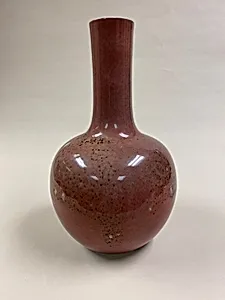
Bottle vase
Unknown Artist
18th century
Medium
Porcelain with copper red glaze (Jingdezhen ware)
Dimensions
H. 15 1/4 in. (38.7 cm); Diam. 9 1/4 in. (23.5 cm)
Classification
Ceramics
Culture & Period
China · Qing dynasty (1644–1911)
Department
Asian Art
Museum
Metropolitan Museum of Art, New York, NY
Credit
H. O. Havemeyer Collection, Bequest of Mrs. H. O. Havemeyer, 1929
Accession Number
29.100.321
Rights
Public Domain
Art Historical Context
This elegant bottle vase, crafted in 18th-century China during the Qing dynasty (164–1911), exemplifies pinnacle of imperial porcelain production at Jingdezhen, the renowned center for fine ceramics. Standing at ¼ inches tall with a 9¼-inch diameter, its graceful swollen form tapers to a narrow neck, designed originally as a flower holder in scholarly gardens or elite interiors. The unknown artist's mastery shines through the medium: translucent porcelain coated in a lustrous copper red glaze, known as sang de bœuf for its deep, ox-blood hue achieved via precise copper oxide firing in wood kilns. The copper red glaze represents a technical triumph revived under Qing emperors, demanding exacting control over temperature and atmosphere to prevent the color from turning green or gray. Jingdezhen wares like this were prized globally, symbolizing China's ceramic supremacy and fueling export trade along the Silk Road and to Europe. Such vases embodied Confucian ideals of harmony and refinement, often adorning altars or studies. Today, this treasure graces the Metropolitan Museum of Art's Asian Art department, part of the H. O. Havemeyer Collection bequeathed in 1929. It invites us to appreciate the anonymous genius behind Qing porcelain's enduring allure.