
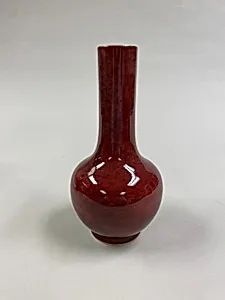
Bottle vase
Unknown Artist
late 17th–early 18th century
Medium
Porcelain with copper red glaze (Jingdezhen ware)
Dimensions
H. 7 1/8 in. (18.1 cm); Diam. 3 5/8 in. (9.2 cm)
Classification
Ceramics
Culture & Period
China · Qing dynasty (1644–1911), Kangxi period (1662–1722)
Department
Asian Art
Museum
Metropolitan Museum of Art, New York, NY
Credit
Bequest of Benjamin Altman, 1913
Accession Number
14.40.55
Rights
Public Domain
Art Historical Context
This elegant bottle vase, crafted in Jingdezhen porcelain with a striking copper red glaze, hails from China's Qing dynasty during the Kangxi period (2–1722). just over 7 inches tall with a slender neck and rounded body (H. 7 1/8 in.; Diam. 3 5/8 in.), it exemplifies the refined aesthetics of late 17th- to early 18th-century imperial ceramics. Jingdezhen, the world's capital, produced wares like this for the imperial court, where potters pushed technical boundaries to create luxurious objects for display or floral arrangements. The copper red glaze, often called "sang de boeuf" for its deep oxblood hue, was a hallmark innovation of the Kangxi era. Achieving this vibrant monochromatic effect required precise control over copper oxide pigments and high-temperature reduction firing—a challenging feat that symbolized technical mastery and artistic prestige. These vases were prized for their subtle gradations from crimson to purplish tones, reflecting the era's obsession with perfection in monochrome glazes. Bequeathed to the Metropolitan Museum of Art by collector Benjamin Altman in 1913, this piece offers a window into Qing opulence, when Chinese porcelain captivated global trade and inspired European makers. Visitors, admire how its glossy surface captures light, evoking the splendor of a bygone imperial age.