
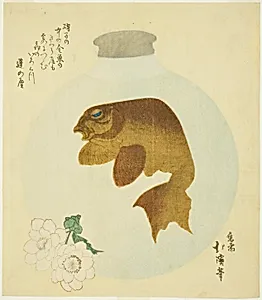
Bottle with a goldfish design
c. late 1820s
Medium
Color woodblock print; shikishiban, surimono
Dimensions
20.5 × 18 cm (8 1/8 × 7 1/8 in.)
Classification
woodblock print
Department
Arts of Asia
Museum
Art Institute of Chicago
Accession Number
81476
Rights
Public Domain
Art Historical Context
Welcome to the Arts of Asia gallery, where we spotlight the exquisite "Bottle with a Goldfish Design" by Totoya Hokkei, created around the late 1820s. Hokkei, a skilled ukiyo-e print and pupil of the legendary Katsushika Hokusai, crafted this charming color woodblock print in the intimate shikishiban format—measuring just 20.5 × 18 cm. This square shape was ideal for personal appreciation, evoking the refined tastes of Edo-period Japan (1603–1868). As a *surimono*, this print represents a pinnacle of private woodblock artistry. Unlike mass-produced ukiyo-e, surimono were luxurious, limited-edition commissions, often for New Year's greetings or poetry circles. Hokkei's vibrant colors and precise lines capture the playful shimmer of goldfish swirling around a bottle, a motif symbolizing vitality and summer leisure. The technique—multiple woodblocks inked with pigments and sometimes enhanced with mica or embossing—highlights the era's technical mastery, blending everyday beauty with poetic elegance. This piece from the Art Institute of Chicago invites us to marvel at ukiyo-e's "floating world" ethos, where fleeting pleasures like a goldfish's graceful dance offered escape amid Japan's rigid social order. A delightful window into 19th-century Japanese culture! (198 words)
About the Artist
Totoya Hokkei · 1780–1850
Totoya Hokkei (魚屋 北渓, 1780–1850), born Iwakubo Tatsuyuki in Edo (modern Tokyo), began his life as a humble fishmonger in the Yotsuya Samegahashi district, a trade reflected in his art name "Totoya," meaning fish shop. He transitioned to art through rigorous training, first studying under Kanō Yōsen'in Korenobu, head of the Kobikichō branch of the prestigious Kanō school, where he honed landscape p...