
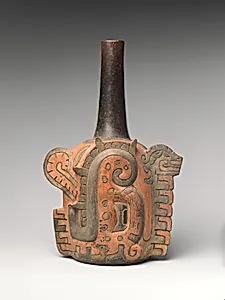
Bottle with caiman
1000–800 BCE
Medium
Ceramic, post-fire paint (cinnabar)
Dimensions
H. 12 3/4 × W. 8 1/16 × D. 5 3/8 in. (32.4 × 20.5 × 13.7 cm)
Classification
Ceramics-Containers
Culture
Cupisnique
Department
Arts of Africa, Oceania, and the Americas
Museum
Metropolitan Museum of Art, New York, NY
Credit
The Michael C. Rockefeller Memorial Collection, Purchase, Nelson A. Rockefeller Gift, 1967
Accession Number
1978.412.203
Rights
Public Domain
Art Historical Context
Step into the ancient world of Peru's North Coast with this striking *Bottle with Caiman*, crafted by Cupisnique artists around 1000–800 BCE. Belonging to the Cupisnique culture—one of the earliest known ceramic traditions in the Andes—this vessel exemplifies the Pre-Columbian fascination with powerful animals. The caiman, a fierce reptile symbolizing water, fertility, and the underworld, is vividly modeled on the bottle's surface, blending naturalistic form with supernatural stylization typical of early Andean art. Fashioned from ceramic and adorned with post-fire paint made from cinnabar—a brilliant red mercury sulfide pigment—the bottle's glossy crimson accents would have gleamed dramatically after firing. This technique, rare for its era, preserved the paint's intensity, highlighting the caiman's gaping jaws and scaly texture. Measuring about 12¾ inches tall, the piece likely served as a ritual container, perhaps for liquids in ceremonies honoring deities or ancestors. Housed in The Metropolitan Museum of Art's Michael C. Rockefeller Memorial Collection, this artifact offers a window into Cupisnique innovation, bridging everyday utility with cosmology. Its survival underscores the culture's mastery of fire and form, influencing later Peruvian styles like Chavín and Moche. A testament to ancient ingenuity! (198 words)