
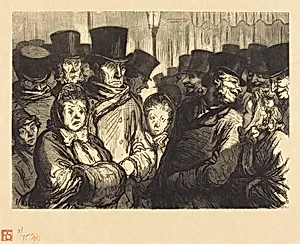
Boulevard du Temple a minuit
Medium
wood engraving
Classification
Portfolio
Department
CG-E
Museum
National Gallery of Art, Washington, D.C.
Credit
Gift of Arthur and Charlotte Vershbow
Accession Number
1978.82.6
Rights
Public Domain
Art Historical Context
"Boulevard du Temple à minuit" captures a nocturnal glimpse of 19th-century Paris through the eyes of Honoré Daumier, one of France’s most insightful chroniclers of urban life. Created in 1862 as a wood engraving by Charles Maurand after Daumier’s design, the print evokes the lively yet shadowy atmosphere of the famous Boulevard du Temple, a center of theaters, cafés, and street activity during the Second Empire. Daumier’s characteristic eye for social detail is preserved in this reproduction, highlighting the contrasts of city dwellers moving through gaslit streets. Wood engraving, a technique prized for its ability to render fine lines and tonal gradations, allowed such images to reach wide audiences via illustrated newspapers and portfolios. Maurand’s faithful translation of Daumier’s original composition demonstrates the collaborative nature of printmaking at the time, when artists and engravers worked together to disseminate commentary on modern life. This work, now part of the National Gallery of Art’s collection through the generosity of Arthur and Charlotte Vershbow, offers today’s viewers a window into how Parisians experienced their rapidly changing city after dark.