
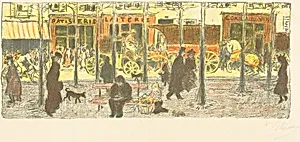
Boulevard
c. 1895/1896 (published 1899)
Medium
lithograph in gray-green, gray-black, yellow and orange on wove paper
Dimensions
image: 17.2 × 43.1 cm (6 3/4 × 16 15/16 in.) sheet: 40.1 × 53.3 cm (15 13/16 × 21 in.)
Classification
Department
CG-E
Museum
National Gallery of Art, Washington, D.C.
Credit
Rosenwald Collection
Accession Number
1943.3.2078
Rights
Public Domain
Art Historical Context
Pierre Bonnard’s *Boulevard* captures the lively energy of a Parisian street at the close of the nineteenth century. Created around 1895–96 and published in 1899 by the renowned dealer Ambroise Vollard, the lithograph reflects the era’s growing interest in printmaking as a modern, accessible art form. Bonnard, working in the vibrant artistic circles of Paris, used the medium’s fluid possibilities to suggest movement and atmosphere rather than precise detail. Printed in subtle layers of gray-green, gray-black, yellow, and orange on wove paper, the work demonstrates the technical sophistication of color lithography at the time. The elongated horizontal format evokes the wide sweep of a boulevard, inviting viewers to imagine the sounds and sights of urban life. Vollard’s support helped bring such prints to a wider audience, bridging the gap between fine art and everyday appreciation. Today housed in the National Gallery of Art’s Rosenwald Collection, *Boulevard* stands as a charming record of fin-de-siècle Paris and Bonnard’s sensitive eye for color and composition.