
Bow Brooch
Unknown Artist
ca. 650–750
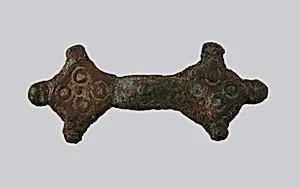
Medium
Copper alloy
Dimensions
Overall: 1 5/8 x 11/16 x 1/2 in. (4.1 x 1.7 x 1.3 cm)
Classification
Metalwork-Copper alloy
Culture
Frankish
Department
Medieval Art
Museum
Metropolitan Museum of Art, New York, NY
Credit
Gift of J. Pierpont Morgan, 1917
Accession Number
17.191.294
Rights
Public Domain
Art Historical Context
This delicate **Bow Brooch**, crafted by an unknown Frankish artisan around 650–750 CE, the exquisite metalwork of early medieval Europe. Measuring just 1 5/8 x 11/16 x 1/2 inches, this copper alloy fastener—shaped like a bowed arch—was not merely functional but a symbol of status. Worn to secure cloaks or tunics, bow brooches like this one were essential accessories among the Franks, a Germanic people who dominated much of western Europe during the Merovingian and early Carolingian eras. Frankish metalworkers excelled in working copper alloys, often casting and hammering the metal into intricate forms that balanced utility with subtle ornamentation. Though modest in scale, this brooch reflects the period's craftsmanship, where everyday objects carried cultural weight—signaling wealth, tribal identity, and social standing. Its survival speaks to the enduring legacy of Frankish artistry, bridging the late antique world and the Middle Ages. A generous gift from J. Pierpont Morgan in 1917, the brooch now resides in The Metropolitan Museum of Art's Department of Medieval Art, inviting visitors to ponder the lives of those who pinned it proudly to their garments over 1,200 years ago.