
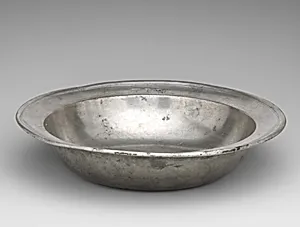
Bowl
Unknown Artist
second half 18th century
Medium
Pewter
Dimensions
2 × 9 7/8 in. (5.1 × 25.1 cm)
Classification
Metalwork-Pewter
Culture
British or Scottish
Department
European Sculpture and Decorative Arts
Museum
Metropolitan Museum of Art, New York, NY
Credit
Gift of Mr. Robert M. Parmelee and Mrs. William L. Parker, 1916
Accession Number
16.116.74
Rights
Public Domain
Art Historical Context
Nestled in the Metropolitan Museum of Art's European Sculpture and Decor Arts collection, this modest pewter bowl hails from the second half of the18th century, crafted by an unknown British or Scottish artisan. Measuring just 2 × 9⅞ inches (5.1 × 25.1 cm), its compact, functional form speaks to the everyday elegance of Georgian-era households. Pewter, an alloy primarily of tin with traces of lead or other metals, was prized for its affordability, durability, and subtle sheen—offering a practical alternative to silver for middle-class dining and serving. In the bustling workshops of Britain and Scotland during this period, pewterers produced vast quantities of such vessels for taverns, homes, and churches, reflecting a thriving craft tradition. This bowl exemplifies the period's metalwork expertise, likely hand-hammered or spun on a lathe for precision, embodying the restrained craftsmanship of the Enlightenment age when utility met quiet sophistication. A generous gift to the Met in 1916 from Mr. Robert M. Parmelee and Mrs. William L. Parker, it invites us to ponder the lives of its long-ago owners—perhaps savoring porridge, punch, or preserves amid the comforts of colonial prosperity. Though anonymous, this unassuming piece whispers tales of transatlantic trade and domestic ritual.