
Bowl
probably ca. 1758–59
Medium
Soft-paste porcelain
Dimensions
3 × 5 7/8 in. (7.6 × 14.9 cm)
Classification
Ceramics-Porcelain
Culture
British, Lowestoft
Department
European Sculpture and Decorative Arts
Museum
Metropolitan Museum of Art, New York, NY
Credit
The Charles E. Sampson Memorial Fund, 1967
Accession Number
67.192.17
Rights
Public Domain
Tags
Art Historical Context
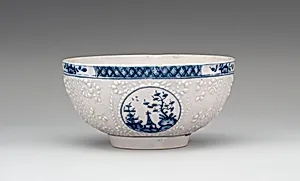
This delicate bowl, produced by the Lowestoft porcelain manufactory in Suffolk, England around 1758–59, early British ceramic innovation. Measuring just 3 × 5⅞ inches, it was crafted from soft-paste porcelain—a, translucent material blending clay, ground glass (frit), and other ingredients, fired at lower temperatures than true hard-paste porcelain from China or Meissen. Lowestoft, active from the 1750s to the 1800s, sought to rival imported luxury wares, making fine tableware accessible to British households during the height of Georgian elegance. The bowl's landscapes, likely rendered in underglaze blue transfer-printing—a pioneering technique at Lowestoft—inspired by Chinese export porcelain and European prints, evoke serene pastoral scenes. This method involved etching designs onto copper plates, inking them, and transferring to the unfired clay for durability. As a product of Britain's growing industrial prowess, it reflects the era's fascination with global trade and Orientalism, bridging decorative arts with emerging mass production. Today, housed in The Metropolitan Museum of Art's European Sculpture and Decorative Arts collection, this bowl highlights Lowestoft's role in democratizing porcelain, acquired through The Charles E. Sampson Memorial Fund in 1967. A charming survivor of 18th-century domestic life!