
Bowl
Unknown Artist
mid 6th century BCE
Medium
Terracotta
Dimensions
Height: 5 9/16 in. (14.1 cm) Diameter: 12 × 7 13/16 × 5 1/4 in. (30.5 × 19.8 × 13.3 cm)
Classification
Vases
Culture & Period
Etruscan · Orientalizing- Archaic
Department
Greek and Roman Art
Museum
Metropolitan Museum of Art, New York, NY
Credit
Purchase, 1896
Accession Number
96.9.165
Rights
Public Domain
Tags
Art Historical Context
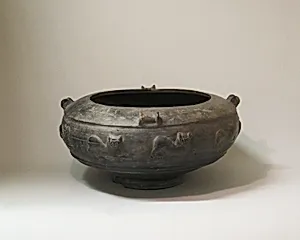
This elegant terracotta bowl, crafted an unknown Etruscan artist in the mid-th century BCE, exemplifies Orientalizing-Archaic period's fusion of local Italic traditions with influences from Greece and the Near East. Housed in the Metropolitan Museum of Art's Greek and Roman Art Department its 1896 purchase, the vessel measures about 5½ inches high with a broad diameter of roughly 12 inches, suggesting its use for serving food or liquids in elite households or rituals. Etruscan pottery like this bowl often featured dynamic animal motifs, such as the lions hinted at in its decoration—symbols of power and protection drawn from Eastern iconography. During this transitional era (roughly 700–480 BCE), artists shifted from the stark black bucchero wares of the Orientalizing phase toward more refined Archaic forms, incorporating incised or painted details that echoed Greek vase-painting techniques. Terracotta's earthy durability made it ideal for everyday and ceremonial objects, reflecting the Etruscans' sophisticated craftsmanship before Roman dominance. Though details of its exact decoration remain subtle, this bowl offers a window into Etruscan daily life and artistry, bridging Mediterranean cultures in a time of vibrant exchange. Visitors will appreciate its timeless form and the roar of ancient lions frozen in clay.