
Bowl
Unknown Artist
6th–3rd century BCE
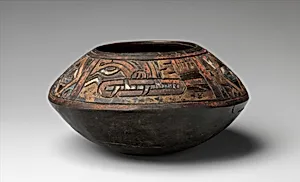
Medium
Ceramic, post-fired resin paint
Dimensions
H. 3 3/4 × Diam. 7 in. (9.5 × 17.8 cm)
Classification
Ceramics-Containers
Culture
Paracas
Department
Arts of Africa, Oceania, and the Americas
Museum
Metropolitan Museum of Art, New York, NY
Credit
Gift of Nathan Cummings, 1963
Accession Number
63.232.4
Rights
Public Domain
Art Historical Context
This elegant ceramic bowl hails from the Paracas culture of ancient Peru, dating to the 6th–3rd century BCE. The Paracas people, who thrived on Peru's southern coast, were masterful artisans renowned for their vibrant textiles and pottery. This shallow, wide-mouthed vessel (H. 3 3/4 × Diam. 7 in.), likely used for serving food or rituals, exemplifies their skill in creating functional yet beautifully decorated containers during a formative period in Andean prehistory. Crafted from ceramic and adorned with post-fired resin paint—a distinctive Paracas technique—the bowl's surface would have been painted after firing using a resin-based medium that resisted cracking and preserved vivid colors. This method highlights the culture's innovative approach to ceramics, bridging everyday utility with aesthetic expression. Though the specific motifs are not detailed here, such vessels often featured bold geometric patterns or symbolic designs reflecting Paracas cosmology and social life. Now part of the Metropolitan Museum of Art's Arts of Africa, Oceania, and the Americas collection (gift of Nathan Cummings, 1963), this bowl offers a window into Paracas ingenuity, predating the Inca by centuries and underscoring the rich diversity of ancient American arts. Visitors will appreciate its timeless simplicity and the enduring legacy of a vanished civilization.